Showing posts with label Retro Lookback. Show all posts

August 3, 2010

What Was Investigation: the Kingdom’s Mr. Toad’s Wild Ride

mtwrext1988

pin52300

One of the Magic Kingdom's opening day attractions, opening on October 1, 1971, Mr. Toad’s Wild Ride was a very unique attraction. Although it was modeled after the Disneyland attraction, it had some characteristics that set it apart from its California counterpart. The most obvious was that the Florida incarnation had two separate boarding areas. The vehicles in each boarding area were on separate tracks that followed different paths, so riders would get a slightly different ride, depending on where they boarded.

pin23167

Like its counterpart at Disneyland, it was not a thrill ride, but it was not slow and quiet like most dark rides. It made sudden turns and often the vehicle would move at full speed towards an obstacle, which would move out of the way at the last second. At one point the vehicles on different tracks would head directly towards each other, giving the sense of an oncoming collision. It was a very stylized attraction and resembled a cartoon more than any other Disney ride. It contained highly ornate plywood characters and sets that were very reminiscent of the multiplane camerawork featured in many Disney films.

The two tracks of this version of the attraction didn't pass through all of the same show scenes. Thus, each track gave riders a completely different set of scenes to pass through.

4e9d43d0

pin50687  pin54587

On Track 1, riders passed through rural English countryside upon leaving Toad Hall, coming face to face with a few cows along the way. After passing through a small room with several warning signs, guests made a turn into a central plaza. Traveling around the turn, the vehicles passed a policeman signaling riders with his whistle. Guests then made a right hand turn into the courtroom as the judge declared Mr. Toad guilty. Upon making a right hand turn, the vehicles entered several jail cells.

4db81730 06edbf40 mtwrbmcbdgr

pin47254

After winding through the cells, guests emerged out into a dark scene, passing by a shootout between police and gunmen (using red lights to simulate gunfire). Several of the police barriers then moved aside revealing a railroad crossing, complete with a ringing bell. The gate then moved aside, and vehicles made a right hand turn onto the "tracks". Vehicles traveled along the railroad tracks, until getting hit by a train (with riders seeing the headlight of the "locomotive"). A door then opened, revealing the "Hell" scene. Afterwards, guests went through a door back to the boarding area.

45e8be00 mtwrshootout 4e4dfb80

From the boarding area to the plaza, Track 2 passed through two scenes not seen in Track 1: Toad's trophy room, and a Gypsy camp. After rounding the plaza, instead of entering the courtroom, guests continued on and entered Winky's Tavern. The vehicles made a right hand turn and guests could see the Weasels hiding out in the Tavern among the ale barrels. Following this, guests emerged into the night countryside. Passing by a small house, the vehicles reached a railroad crossing with ringing bell. This gate moved aside, and vehicles made left hand turn onto the railroad tracks. Like on Track 1, the headlight of the locomotive was visible before the train hit the riders. The "Hell" scene on this track was a mirror image of the Track 1 "Hell" sequence.

mtwrwinky mtwrwinkys1 toad_bull_cow

Despite the ride's popularity and many protests, Mr. Toad's Wild Ride closed on September 7, 1998 and was replaced with The Many Adventures of Winnie the Pooh. This was due to the characters in Winnie The Pooh having similar characters to The Wind In The Willows, and Winnie The Pooh being a Disney-Owned product. While minor tributes to the ride can be found in Disney World, including paintings of Mr. Toad and Moley within The Many Adventures of Winnie the Pooh and a statue of Toad in a pet cemetery outside of Haunted Mansion, traces of "The Wind in the Willows" characters within Walt Disney World are minimal.

pin49340 pin59863 pin74891

The final pin was released as a part of the final Piece of History series in Walt Disney World, and it featured the much loved attraction, Mr. Toad’s Wild Ride.pin46288

Pictures and Information from Widen Your World, Walt Dated World and PinPics

July 29, 2010

What Was Investigation: Meet the World

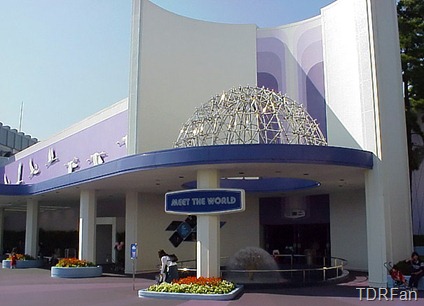
Meet the World has had a somewhat long history before even opening in Tokyo Disneyland. Konosuke Matsushita, founder of the Matsushita Electric Industrial Company, had a strong interest in Japanese history and in Walt Disney's visions, and pressed Disney to build a Japanese analog of the American "Hall of Presidents" attraction. It was originally planned as part of the Japan pavilion in World Showcase at Epcot. Planners went so far as to construct the show building, which was never used.

exterior

tommtw001 tommtw002

pin15133

Among other issues, certain politically sensitive issues such as World War II were noticeably under-emphasized in the show. The show mentions that there were some "dark days" between the Meiji Restoration and the "Japan of today", which left Disney management nervous about possible reactions from guests (specifically American veterans and other groups) over such a dramatic conflict in history being 'glossed over' as 'dark days', despite other attractions in the Disney cannon having unbiased references to the same time period. Concept art and models were featured in the 1982 book, "Walt Disney's EPCOT Center".

Opening with Tokyo Disneyland on April 15, 1983, Meet the World was a show which explored the history of Japan over the course of 19 minutes, focusing specifically on the history of Japan's engagement with the outside world. The show featured an animated crane explaining Japanese history to a young boy and girl from Yokohama. The show featured dialogue between a number of audio-animatronic figures and a movie screen in the background. The show was presented in a rotating theater, similar to the Carousel of Progress. However, they were designed in the opposite way. In Tokyo, the audiences sat in the rotating theater inside with the stages built around. Meet the World's layout meant less audience capacity but a larger stage area.

tommtw006

gallery005

The show opens with two children from Yokohama discussing the ancient creation of Japan. Soon, an anamorphic crane appears to tell them the whole story. She takes them back through time to uncover the ancient Jōmon people and the difficult relationship they encountered with the sea and land. But it changed in the next era when Prince Shōtoku devoted his efforts to 'meet the world' and created a constitution and explored Chinese culture and in turn brought Buddhism, arts, and writing systems to Japan. The crane then takes them forward into the past.

gallery007

tommtw013

They arrive at Tanegashima where Portuguese traders meet with locals introducing Japan to new trade opportunities as well as the outside world. Additionally firearms and Christianity are introduced during this period, however because of these elements the Sakoku policy of self-exile is enacted leaving the country in isolation apart from limited trade with the Dutch and Chinese at Nagasaki. Only when US Navy Commodore Matthew C. Perry arrives with his Black Ships does the exile end and Japan 'meets the world' again. The shogun retires and signals the time of the Meiji Restoration. However, the ruling power takes the idea of 'meet the world' from a peaceful one to a destructive and aggressive one. As a result, Japan soon enters dark days, but the crane reassures the two young children that those days have ended and that Japan now leads the way of today.

gallery010    tommtw011

The young boy asks the crane if she is the "Spirit of Japan", but she responds that he and all the other people are the "Spirit of Japan". A final montage of Japan's modern accomplishments brings the show to a close as the young children and the crane soar to the skies on a hot-air balloon.

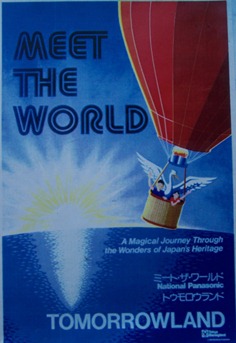
Matsushita Electric was its initial sponsor, and subsidized the attraction so that it was one of the few free attractions while the park still used ride tickets. Konosuke Matsushita died in 1989 and Matsushita shifted its corporate sponsorship to the nearby Star Tours attraction around that time; Japan Airlines then took over sponsorship of Meet the World for a short period.

tokyo_posters_026

The attraction closed for good on June 30, 2002, and in the Summer of 2006, Meet the World's show building was demolished to make way for Monsters, Inc. Ride & Go Seek.

Meet the World was one of the few attractions in the park that dealt with Japan; the other was a film, Eternal Seas, found in the future Magic-Eye Theater. The Oriental Land Company, the owners of the park, specifically wanted the park to focus on the American way of life and the American parks of Disneyland and Walt Disney World.

Pictures and Information Courtesy of JTCent, TDR Fan, and PinPics

July 27, 2010

What Was Investigation: Mickey Mouse Revue

Magic_Kingdom_-_Mickey_Mouse_Music_Revue_poster

pin51973

Originally opening in Magic Kingdom on October 1, 1971 as an opening day attraction in Fantasyland. It was a ‘main’ E-Ticket attraction in Fantasyland West. In 1973 it was downgraded to a "D" ticket - an extremely rare occurrence. It continued to pull an audience, but never gained the prominence that had been expected for it. The  Oriental Land Co. began touring Disneyland and WDW in the 1970s and choosing the attractions that would comprise their new Tokyo Disneyland park, the Mickey Mouse Revue made their list. Of course, the least expensive means of achieving that would be to send the original overseas. It was the only attraction at either Disneyland or WDW that was shipped to, rather than replicated for, Tokyo. It was closed on September 14,1980 to be shipped to Tokyo Disneyland. The original Magic Kingdom attraction theater was designed to hold 500 people, but the preshow area was only designed to hold 300…whoops.

mmrext

Spread out across 35 feet of the stage area, the orchestra's members, ranged from cartoon short stars such as Minnie, Goofy, Daisy and Pluto to earlier feature film personalities like Dumbo, Timothy Mouse, the Mad Hatter, March Hare, the Dormouse, Gus and Jaq all the way up to more recent film performers like Baloo, Kaa, King Louie, Winnie the Pooh, Piglet and Rabbit.  Their instruments were varied: tubas, tympani and trumpets, ukuleles, kazoos and clarinets. 

010

tdl_9

0815fb60

1ee7b160 gallery008

54db80e0  mmrdumbo

The orchestra played a medley of familiar Disney tunes, starting with "Heigh Ho," then moving on to "Whistle While You Work," "When You Wish Upon A Star" and "Hi Diddle Dee Dee."At the conclusion of that brief overture, Dumbo's tuba intoned the first few notes of "Who's Afraid Of The Big Bad Wolf" as the wolf's shadow snuck across the rear curtain toward center stage.  Further right a section of the curtain rose to reveal the Three Little Pigs in a cross-section of Practical Pig's brick house.  The pigs played and sang a few seconds of their signature song before the curtain closed over them and another section lifted to the left.

mmrpigs

The next vignette featured Snow White and some forest animals sitting on a wooded hillside.  She sang a version of "I'm Wishing". As Snow White finished, an adjacent area of the hillside came into view from behind another section of rising curtain. Here the Seven Dwarfs stood in their cottage, playing "The Silly Song." 

mmrdwrfs

mmrburnsdwarfs 54535f00 gallery003

gallery004

To the far right end of the stage the curtain rose on a scene from Alice In Wonderland, with Alice standing in the midst of fifteen oversized flowers.  As Alice and the flowers swayed in time, she sang part of "All In The Golden Afternoon."  1f020d10 004

The next scene was from "The Three Caballeros," the show's most animated and comical segment.  As soon as Alice's song drew to a close, a flying carpet rose from the pit to the left of the orchestra.  On the carpet were Donald, Panchito and Jose Carioca.  They broke out into the main theme from "Three Caballeros" in a blaze of music and color, with Donald on maracas, Jose on guitar and Panchito firing two pistols.  Each shot sent sparks of bright light streaking across the room.

1ef20c60   mmr3cbl

The three had barely begun their song when the lights went out on the carpet.  Instantaneously, Panchito and Jose appeared (still singing) on the small side stage to the audience's right.  Then Panchito fired a pistol and the glow of his bullet raced across the stage, illuminating Donald on the left side stage. Donald shook his maracas vigorously and continued the song like the frantic duck he is. With the sound of another ricocheting bullet, he disappeared and reappeared on the right side stage. Another shot and Panchito and Jose popped up where Donald had been just seconds prior. Moments later the three were reunited on the carpet, where they quickly finished the song and disappeared as quickly as they'd arrived.  This was definitely a highlight of the show. The sight of Donald wiggling around so fast was absolutely infectious.

The next vignette began with the Fairy Godmother and Cinderella, in her scullery maid outfit, standing at the far left side of the stage.  The Fairy Godmother sang "Bibbidi-Bobbidi-Boo" and waved her wand around.  Soon, in a shower of twinkling lights, Cinderella was transformed into her princess incarnation. Then the rear curtain lowered as a projection of Cinderella and Prince Charming, as silhouettes, danced across it in a spotlight.  They sang "So This Is Love" as they waltzed.

5425fd30

003

gallery007

When the projection faded out, the sound of the orchestra came rising up from the pit. To the right, Brer Fox, Brer Bear and Brer Rabbit rose into view and began singing "Zip-A-Dee-Doo-Dah."

mmrsots

As they sang, the orchestra rose beside them. The Three Caballeros reappeared also, and then the rear curtain lifted to reveal all of the show's scenes at once. The houses of the Three Little Pigs and Seven Dwarfs were gone, leaving all the characters contrasted against a brightening sky in the background. Cinderella now stood with Prince Charming, and everyone joined in the song.  A rainbow gleamed across the horizon as the voices and instruments of all the characters reached a crescendo.

At the close of the song, the entire stage fell dark save for a spotlight on Mickey.  His pedestal spun to face the audience as the other characters sang the "Mickey Mouse Club Alma Mater."

tdl_11

001

tdl_10

The Tokyo Disneyland ‘version’ of this attraction opened with the park on April 15, 1983. The Mickey Mouse Revue played almost identically to its staging in Florida for another 26 years in Tokyo.  The beautiful holding area art was faithfully reproduced, the pre-show film footage was the same except for the final live-action segment and the show scenes ran in the same order with the same music.  The largest difference was that the voices were recorded in Japanese. There were some minor changes in the set colors and a handful of modifications to the characters themselves, like Kaa's eyes were in slightly more of a hypnotic trance mode in Japan than in Florida, but he still played his tail.  In 2008 news came out that Tokyo Disneyland would replace The Mickey Mouse Revue with its own version of Mickey's Philharmagic.  The attraction finally closed in Tokyo on May 29, 2009 to make way for Mickey’s Philharmagic. 012  Mickey%20Mouse%20Review%201 pin4233

Check out this video of the Tokyo Disneyland ‘version’ of the attraction. It is in Japanese, but mostly it is instrumental, so you can understand it. (Video by ParkHopper on YouTube)

So, what’s is/was your favorite scene from the Mickey Mouse Revue? Tweet me, Facebook me, or even just comment here in the comment section.

Pictures and Information Courtesy of Widen Your World, Walt Dated World, and TDR Fan