Showing posts with label Tokyo DisneySea. Show all posts

October 20, 2010

Pinvestigation: Hightower Hotel

tds_tot_big

amwtow166

The Tower of Terror at Tokyo DisneySea has no connection or tie-ins with The Twilight Zone, and is instead themed as the Hotel Hightower, an 1890s' New York City hotel owned by eccentric billionaire Harrison Hightower III who disappeared on December 31, 1899 while taking the elevator up to his private quarters shortly after taking a mysterious idol of a trickster spirit called Shiriki Utundu from an ancient civilization in Africa.

The ride's facade is an example of Moorish Revival architecture, and the Tower is located in the American Waterfront area of the park, close to the S.S. Columbia cruise liner. The ride system for this version is similar to that of Disney's California Adventure's version and that of Walt Disney Studios Paris' version.

The story of this Tower is much more complex then the others. The story follows the adventures of the hotel's famous builder, Harrison Hightower. Having completed many expeditions around the world and collecting thousands of countless artifacts, all of which he stored in his hotel. As it would turn out, he actually stole these many items for his own personal gain. After one such expedition to Africa, he brings home an idol by the name of Shiriki Utundu.

amwtot668

amwtow169

He claims that the natives were very unhappy to part with their beloved god and threatened him that it would curse him. On December 31, 1899, Hightower held a huge party, attended by many members of the press. There he boasted about how great he was for taking the idol and denied any claims to it being cursed and even went so far as to insult it. He even used the idols head to put out his cigarette. Around midnight, he entered the elevator to retire to his quarters at the top of the hotel. As the elevator neared the top, Shiriki Utundu came to life.

The idol zapped him and the elevator, causing it to drop and crash at the bottom. When the elevator was finally pried open, only Hightower's hat and the idol were found. The hotel was then abandoned and left for many years, claimed by the locals to be haunted. After several years, in 1912, a woman from a New York restoration company reopened the hotel with paid tours available. It is on these "tours" that guests embark on when they enter the hotel.

amwtow147     amwtow150

The queue starts outside the hotel and winds through the gardens, all filled with many fascinating statues from many different countries. Signs are posted all over the front advertising the tour. Guests then enter the lobby, a very elaborate and well-decorated room filled with lush furniture and beautiful art. Across each arch near the ceiling is a mural of Hightower on one of his adventures. If one looks closely, they will notice that he is actually escaping the people in some way with a valuable artifact or item in his possession. At the end of the lobby are the elevator doors, broken open slightly and held in place by a plank of wood. The broken cable is visible inside. Guests are then ushered into a room filled with many pictures of Hightower, his expeditions, and his hotel.

amwtow063

Guests then enter one of two rooms, either his office or the library. From here the story is the same, in both rooms, a large stained glass window of Hightower is in the middle with Shiriki Utundu sitting on a pedestal nearby. A tour guide talks about Hightower a little bit, then winds up an old gramophone with a recording of Hightower's last interview. At this point, the stained glass window comes to life. The window changes to show Hightower holding the idol. It then shows him entering the elevator and the doors closing. It then shows the outside the hotel as the elevator ascends. Suddenly, all the lights on the hotel turn off, there is a big blast of green lightning and the elevator drops, leaving a shattered hole in the window where it lands.

amwtow059

amwtow075 amwtow085 amwtow088

At this pont, Shiriki Utundu comes to life. It looks around with an evil grin on its face before laughing evilly and vanishing into a starfield. (This effect works with the room going dark, the projection that gives the doll its features turns off and it drops into the pedestal. The starfield is done by fiber optics on the pedestal, idol, and wall.) Guests are then ushered into an enormous storage room (the loading room). The room is two stories and is filled with countless artifacts from countries all over the world, from statues to furniture. There are multiple loading rooms on the second floor, each themed to a different type of item. One has swords, another has tapestries, another has masks, another has stone tablets.

Guests are then put into rows and loaded into an elevator. The restraints are over the shoulder and waist seatbelts, similar to car seatbelts. The doors close, the elevator goes dark, and pushes away from the doors. Suddenly, the idol's eyes appear on the door, a starfield appears, and Hightower continues talking about the idol. The elevator begins its ascent. The first stop is in front of a long hallway. Shiriki Utundu sits on a table and Hightower's ghost appears next to it.

tokyoidol

He reaches out to touch it, but the idol zaps him into the elevator opposite the hall, it then drops. The idol turns toward the guest's elevator and its eyes glow menacingly as the hallway vanishes into a starfield. The doors close and the elevator ascends another level. This time the doors open, revealing a large mirror, Hightower tells the guests to wave goodbye to the real world. As they do, green lightning fills the mirror and the guests' reflections becomes green and ghostly.

It then vanishes altogether and the idol appears in the mirror. He starts laughing evilly and zaps the elevator with his eyes. The elevator then ascends rapidly to the top and begins the drop sequence. At some point the doors open at the top and a camera takes a photo of the elevator riders while giving them a view of the park. After the drop sequence ends, the elevator pushes back to the doors with idols eyes still on it. Hightower tells the guests how lucky they are to have survived. Guests then exit into a gift shop where they can buy their picture and other Tower of Terror merchandise.

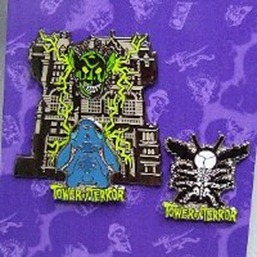
Most of the pins for this attraction either feature the building, similar to the concept art and pin below, or the sacred idol that Hightower stole.

pin48039

This series of pins was released on the opening of the attraction and featured each of Tokyo DisneySEA’s lands ‘mascot character’ getting cursed/scared by the idol, and all can be placed on the final card (pictured below) with Mickey on it.

pin48283      pin48297

pin48298      pin48299

pin48300

pin51795     pin48440 

pin60452

As most pins feature the idol, only this Walt Disney Imagineering pin feature Harrison Hightower III in this ID Badge, from the set. pin51808

Pictures and Information from Pin Pics and JTCent

October 12, 2010

Tower Origins

sunsetconcept1

Originally as an idea for a Disneyland Paris attraction, the concept for a ‘free-fall drop’ attraction began in the 1980s. Part of the original plans for Disneyland Paris was Geyser Mountain in Frontierland - just past Phantom Manor, next to the geyser that exists today. This would have been a mine train ride through a mountain, with a geyser bursting out from the tracks and catching your train from below. then pushing it up a chasm and out of the top of the mountain - and dropping you back down onto the tracks. The water jets would have hidden an elaborate free fall mechanism. This attraction never got off the planning stage, but the idea stayed in Paris. Discovery Mountain was to be built soon after DLP opened in April 1992, being twice as large as the present Space Mountain. As well as housing the space rollercoaster, there was to be a Journey to the Center of the Earth attraction and had a freefall ride vehicle. At least 2 versions of this were looked at - one had a vehicle with a `drill` underneath it to plunge straight down into the floor (volcano), the other was a more elaborate steel rig where the ride would either start or finish with the passenger vehicle on its side in a curved spur off of the main drop shaft. Due to DLPs financial issues, Discovery Mountain was shrunk into Space Mountain, and so the idea was put away again.

Once the Disneyland Paris ideas were scrapped, the Walt Disney Company was looking to expand Disney-MGM Studios, which was, at the time, a small park with shows, and three attractions. The expansion would involve a new ‘land’ area coming off of Hollywood Boulevard, Sunset Boulevard. All early plans for the land were scrapped, from a Mickey Movieland, to a Roger Rabbit attraction with licensing issues, and Dick Tracey film struck out in theaters. What was needed was a major E Ticket Attraction, and they preferred that it would act as a weenie for the new land, to move guests past and thru the shops of Sunset. Space was reserved for future attractions on Sunset (Rock 'n Roller Coaster`s plot, Fantasmic!'s plot, the third plot between these two and the Farmers Market area - always planned to be a temporary structure.) Until these spaces were filled, the Disney-MGM Studios needed a must see at the end of Sunset. The Imagineers dug out the free fall attraction plans.

sunsetconcept

In the fall of 1989, Mel Brooks, Michael Eisner, Marty Skylar, C. McNair Wilson and the rest of the Imagineering group met together. It was the beginning of an attempt by Eisner to bring Mel Brooks over to Disney to produce his films at the then brand new Disney-MGM Studios. Mel initially had to be sold on the idea of a theme park attraction after being explained that a theme park attraction has a lasting effect of being in place and seen every day of the week by about 20,000 people for anywhere from 10-20 years. Mel Brooks made about six trips to Imagineering and a number of telephone calls to work on the attraction. Disney Imagineers wanted to shoot for something scary and funny with Mel Brooks and at one point in the early development with Mel Brooks, what later became the Tower of Terror started out as "Castle Young Frankenstein" which would have featured a Bavarian village with winding streets to the castle with a drawbridge. The queue line would be towards the back of the "village" with a kind of indoor line that had the feel of Pirates of the Caribbean in the Magic Kingdom. The idea later changed to "Mel Brooks' Hollywood Horror Hotel".

Around the time the Disney-MGM Studios was opened, Bob Weiss wanted to do a 1930's art-deco high-end 4 or 5 diamond hotel at the front of the Disney-MGM Studios. Because murder mysteries were all the rage in the 1930's, McNair mentioned to Bob Weiss an idea for the hotel to build in little clues that could be found all around the grounds of the hotel and would be a mini scavenger hunt and had ideas like all the hotel staff would know little key phrases that would lead guests onto other clues and you could solve it and the end you could get a certificate that the guest had solved the mystery of the hotel. This idea lead to another idea of the Hollywood Hotel having one end being covered in ivy and had broken windows and was falling apart and when you went into the hotel, if you went down the hall to that section, it would say "closed" or "condemned" and that part would be the Hollywood Horror Hotel so that it was two buildings but it would look like it was one large building.

motel

Some other ideas were tossed around, including an idea to incorporate Mel Brooks into the Studios was to do a "comedy Haunted Mansion" that would feature Castle Young Frankenstein on the same grounds in case the elevator based attraction was scrapped. Mel Brooks eventually left the project at the time Disney Imagineers had some firm ideas and towerconcept1brought in an idea to have a moving elevator off it's track and moving down hallways and crash out one side of the building and they had architects and engineers brought onto the project and Mel lost interest partially because Disney wasn't building on Mel's original idea anymore. Once Mel Brooks had left, Imagineers started to figure out what the new attraction would look like and budgets and so forth and played with it some more and with Mel leaving, Imagineers started leaning toward that Spanish-Renaissance/Riverside Mission Inn "look" because of the great architecture and because it would fit in with the eclectic store fronts on Sunset and Hollywood Boulevards. Disney felt the attraction needed a movie reference and eventually settled on the Twilight Zone theme after calling around and see what movie rights were available. The Twilight Zone theme was a fairly easy overlay for the Disney Imagineers and went through all the Twilight Zone episodes to pick elements from the series although the theme did not change the towerconcept5attraction much. The one element that was lost in all of this was the comedy aspect to it that Mel Brooks had wanted but with Mel gone, Imagineers focused on the eeriness and thrill of the attraction with a Twilight Zone theme to it.

One of the initial ideas for the Tower of Terror attraction was to have a bench near the queue with a man sitting down, hunched over with a newspaper in his lap and cobwebs between him and the newspaper and he would slightly move his head to the left and right and when he would sense a guest starring at him, he would "come to life", revealing he is a live actor and start conversing with the guest. There was another idea of having audio-animatronics including a elevator repair man sleeping in the boiler room. But this and other ideas were eventually scrapped because they slowed the line down too much, also because the line barely was in the lobby where the theme.

Now that they have their idea, the Imagineers had to think of a story to fit into theme of the park. After much consideration, the Imagineers finally found one towerconceptthat seemed to work, the plot revolved around a studio wrap party in a modern day hotel, where the owner started to kill the guests. Management knocked this back straight away due to the murder storyline. Next up was a narrated by Vincent Price, with a part walk through, part ride about a group of movie stars staying in a hotel and who disappeared during a storm. As the walk through progressed, clues would tell the story bit by bit, until you enter an elevator and what happened becomes all to obvious - and its too late to get out. Eisner liked this story, but wanted the guests to be more involved. And so the Twilight Zone theme was worked in, with guests starring in their own `lost` episode. The ride through portion of the attraction became the queue area - hence its great theming and little clues all around - and the boiler room holding area. Twilight Zone themes were worked into the attraction, but it became apparent the original freefall ride vehicle would have to do a lot more. Disney initially involved Otis elevators, who paintconceptbalked at the idea of a freefall car - they had spent 140 years making elevators feel like they were stationary.

The Fifth Dimension idea played a strong part of the story from the beginning - and it became the ideal transition from Ride shaft to drop shaft (early plans called for the 5th Dimension floor to be in the basement, having descended from the corridor scene, and then to rise to the top of the building and move into the drop shaft without a show scene.) To maximize capacity without duplicating everything it was decided to have 4 ride shafts but only 2 drop shafts. This, and the 5th Dimension transition, called for a new type of ride vehicle. Imagineering had to have an elevator car, but one that could also move horizontally. Disney had to think of their own ride system and vehicle, the Autonomous Guided Vehicle. A self controlling self contained ride vehicle, that could move without track. Although the 5th Dimension floor has guideways for traction, the vehicle itself runs on its own wheels along the floor. Such a vehicle needed to have onboard power, with fast charging. Inductive power coupling was designed for EPCOT Centers Universe of Energy travelling theatre cars by Inductran Corp, and can recharge onboard batteries without a physical connection. This technology was refined for Tower of Terror, and also used later in Tokyo Disneyland`s Poohs Honey Hunt. Onboard computers follow a pre programmed ride path, and `talk` to the Ride Control System via a wireless frequency. A secondary tracking system follows a wire embedded in the floor to keep track of the AGV`s location, and these can easily trigger a ride shutdown if a carelessly discarded park map comes between it and the underside of the AGV.

towerconcept2

August 12, 2010

Resort Round-Up: Disney’s Ambassador Hotel

pin2153

Opening July 20, 2000, Disney’s Ambassador Hotel was the first ‘official’ Disney Hotel to open in the Tokyo Disney Resort, but was the sixth overall hotel to open. It was licensed under the Walt Disney Company, but is managed by the Oriental Land Company. It's Art Deco style takes an early Hollywood theme, its theme is very similar to Hong Kong Disneyland’s Hollywood Hotel.

96006_1

The hotel features several room types:

-Standard Room
-Superior Room
-Triple Room
-Donald Duck Room—they face the ‘Palm Garden Pool’, everything has ‘Donald Duck’ colors
-Deluxe Room
-Family Room

There are also a variety of hotel Suites:

-Garden Suites
-Panorama Suites
-Fantasia Suites
-Mickey’s Premiere Suite
-Mickey’s Penthouse Suite

st_ph5_2

The hotel has many restaurants and lounges throughout, including:

-Chef Mickey--The Disney characters come to greet you at your table at this casual, buffet-style restaurant. Feast on just what you like and have a great time with your family.
-Empire Grill--The hotel’s premier restaurant takes the essences of styles such as Italian, Mexican and Asian cooking and uses them to create a sophisticated California-style cuisine.
-Restaurant Hana-- A refined Japanese restaurant offering Kaiseki course menus, Teppan-yaki grill dishes and other seasonal delicacies.
-Tick Tock Diner-- Styled after a 1950s diner, this is the place to stop for some coffee, soup, or an original sandwich.
-Hyperion Lounge-- The art deco interior lends this lounge a refined atmosphere, with the player piano from the lobby adding a special ambience.

96006_12

As opposed to the rest of Tokyo Disney Resort, the Ambassador Hotel has many pins, and for every anniversary a series of pins is released. Each year every restaurant celebrates the anniversary, and the hotel has a big event.

pin6945      pin13063

pin23715      pin34283

pin40215      pin41540

pin48217      pin55616

pin58006     pin60570

pin67962     pin72099 

Several pins use the Art Deco style of the hotel and reflect it, like the early years Mickey and Minnie below.

pin7612

pin7611

Most of the restaurants don't have pins, but Chef Mickey does. The restaurant is similar to Chef Mickey’s at Walt Disney World’s Contemporary Resort.pin13244  pin69349

This post is part of the Disney Blog Carnival. Head over there to see more great Disney-related posts and articles. (http://dismarks.com/blog/disney-blog-carnival-9)

Pictures and Information from Official Tokyo Disney Resort and Pin Pics